


Kabaka Ronald Muwenda Mutebi is presently receiving treatment at Namibia’s Okonguarri Psychotherapeutic Centre, a private mental health hospital
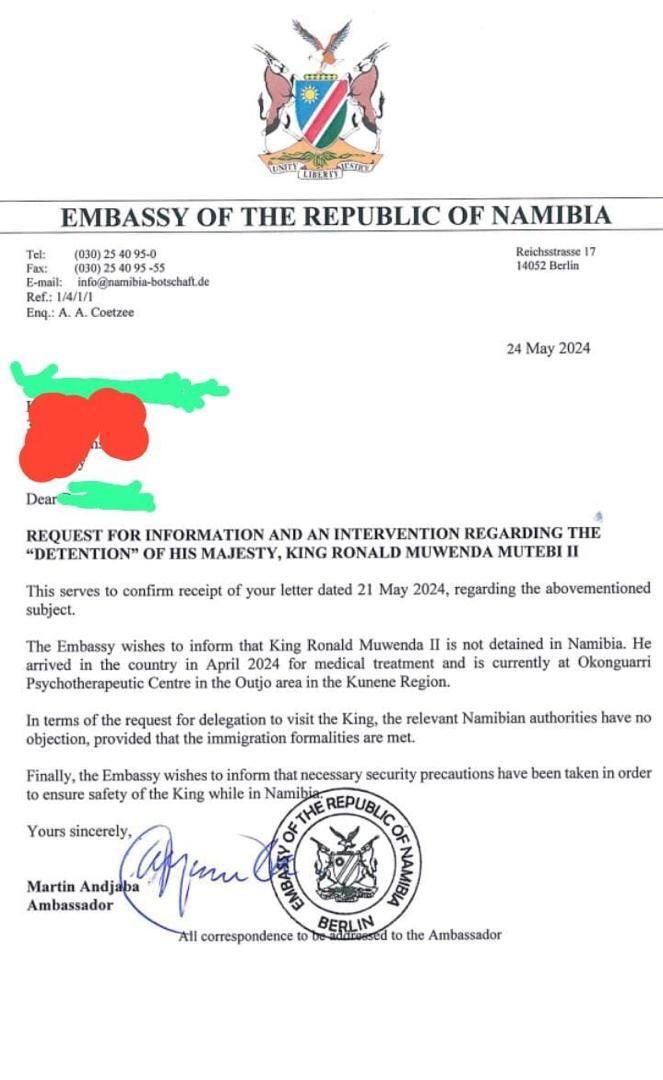
In response to a letter dated May 21 from a concerned Ugandan (names omitted) requesting clarification on rumors that Kabaka is being “held in Namibia,” Namibia’s ambassador to Germany, Martin Andjaba, verified this.
Germany is home to the Ugandan.
In response, Andjaba stated on May 24 that, contrary to what certain social media outlets have claimed, Kabaka is not being held in Namibia. On the other hand, Andjaba attested to Kabaka’s medical visitation in Namibia.
“He arrived in the country in April 2024 for treatment and is currently at Okonguarri Psychotherapeutic Centre in the Outjo area in the Kunene Region,” Andjaba wrote.
He wrote that security measures had been put in place to guarantee the King’s safety during his visit to Namibia.
The Kabaka’s exact condition is unknown, but the facility’s website states that it provides individualized treatment sessions for people with post-traumatic stress disorder (PTSD), personality dysfunctions (psychosis), depression disorders, anxiety disorders, somatoform disorders, substance-related disorders, and childhood-related disorders.
Some Baganda have been uneasy by Kabaka’s protracted absence from public gatherings for months.
Katikkiro Peter Mayiga informed Lukiiko last month that the Kabaka was recovering from surgery performed overseas.
Later, images of the Kabaka meeting with Joseph Ndawula, Uganda’s ambassador to Namibia, at what looked to be an eco-lodge surfaced.
It now appears that Kabaka went on vacation at Okonguarri Psychotherapeutic Centre based on the images.
Concerning the establishment
The establishment was founded in 1996 and serves patients from all over the world, according to its website.
“Guests are treated to the beauty and purity of Africa in all its splendour,” the establishment states, and it is situated on a 5000-hectare tract of pure wilderness.
German psychologist Herman Raath founded it.
Raath claimed that after learning that historically, mental health facilities had been overrun with patients and had neglected to provide individualized care and one-on-one attention, he was motivated to open the hospital.
“The obvious solution to this was a unique and smaller, patient-friendly therapeutic environment, adaptable to the specific treatment needs of every individual,” Raath wrote.

